Table of Contents
ToggleHow Insulating Glass Molecular Sieve Works?
Introduction
Fogging occurs inside sealed double-glazed units when water vapour or solvent vapour condenses on the glass surface. This happens when the glass temperature falls below the dew point of the air trapped between the panes. The root cause is that the presence of moisture and solvent vapours in the sealed air cavity. But insulating glass molecular sieve desiccant placed inside the glass unit adsorbs these vapours, reducing the water vapour concentration in the air layer.
This article explains what molecular sieve does in insulating glass, why only one specific type works, and how to use it correctly.
What is an Insulating Glass Molecular Sieve?
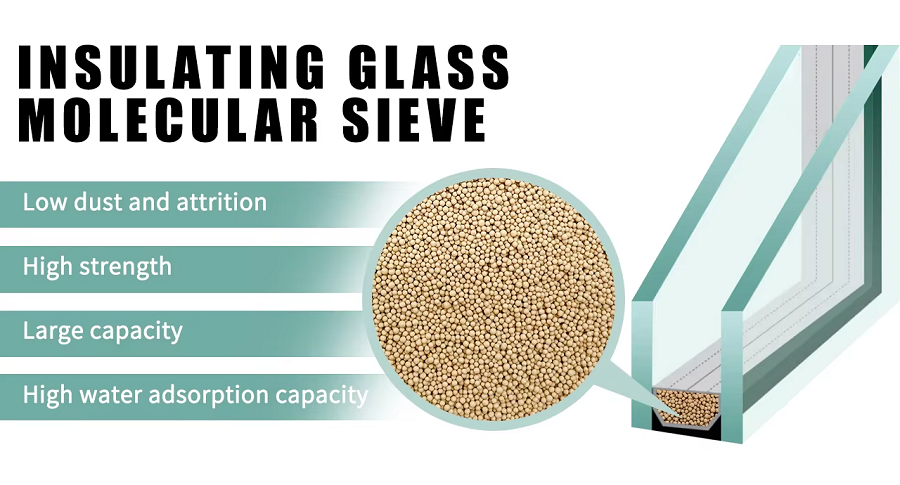
Insulating glass molecular sieve is a porous adsorbent specifically designed for use within the spacer bars of insulating glass units (double or multi-pane glazing). Primarily composed of synthetic zeolite—typically featuring a 3A crystal structure—this material leverages high water-absorption capacity and excellent physical properties to deeply co-adsorb residual moisture and organic compounds from within the unit. This ensures the glass remains clear and transparent even at extremely low temperatures, thereby significantly extending the service life of the insulating glass windows.

Why Insulating Glass Needs a Molecular Sieve?
Insulating glass consists of two or more panes of glass separated by a spacer bar, creating a sealed air cavity in between. This cavity is what gives insulating glass its thermal and acoustic performance. However, if moisture builds up inside this cavity, several problems can occur:
- Condensation and Fogging: Water vapour condenses on the inner surface of the glass when the temperature drops, obstructing visibility.
- Reduced Thermal Performance: Dry air has a thermal conductivity of 0.021 W/(mK), while water has a conductivity of 0.5 W/(m·K). Moisture inside the cavity dramatically reduces insulation efficiency.
- Glass Distortion: Changes in temperature and pressure can cause the glass panes to bow inward or outward, affecting both appearance and safety.
A molecular sieve is placed inside the spacer bar to continuously absorb moisture from the air cavity, keeping the interior dry throughout the life of the window. It also adsorbs residual organic solvents that may be released by sealants during production.
Why 3A Molecular Sieve Is the Best Choice in Insulating Glass?
Not all molecular sieves are suitable for insulating glass. In fact, using the wrong type can cause serious problems. Water molecules measure about 0.28 nm in diameter. Oxygen molecules are about 0.34 nm, and nitrogen molecules are about 0.36 nm. Different molecular sieves have different pore sizes, 3A molecular sieve has pores of 0.3 nm—large enough for water molecules to enter, but too small for oxygen and nitrogen to pass through. This makes it the only type that selectively adsorbs water without touching the air inside the cavity.
If a 4A molecular sieve is used instead of 3A Insulating glass molecular sieve, it will adsorb not only water but also oxygen and nitrogen from the air cavity. Here is what happens:
- When the temperature drops, the molecular sieve adsorbs more air, creating a partial vacuum inside the cavity. The glass panes bow inward.
- When the temperature rises, the sieve releases the adsorbed air, increasing the internal pressure. The glass panes bow outward.
- This repeated expansion and contraction—known as the “breathing effect”—puts constant stress on the sealant and the glass itself. Over time, it can cause the seal to fail or even lead to glass breakage.
For this reason, industry standards explicitly require the use of 3A zeolite desiccant for insulating glass.
Key Performance Requirements of Insulating Glass Molecular Sieve
High-quality 3A molecular sieve for insulating glass must meet strict performance criteria:
- High water adsorption capacity:Static water adsorption should be at least 21%t. This ensures the sieve can keep the cavity dry over many years.
- Low nitrogen adsorption:Nitrogen adsorption should not exceed 1.0 mg/g. This confirms that the sieve truly has 3A pore size and is not adsorbing air.
- Low dust content:Dust or powder from the sieve can settle on the glass surface, affecting transparency.
- Low packaging moisture:The sieve must be packaged with very low inherent moisture content (typically below 1.5%) to maintain its adsorption capacity.
- Proper particle size:Common sizes are 0.5–8 mm for machine filling and 1.5–2.0 mm for manual filling.
- Mild alkalinity:3A molecular sieve has a pH of about 10.5, which does not corrode the aluminium spacer bar.
- Sufficient crush strength:The granules must withstand the filling process without breaking into dust.
How to Use Molecular Sieve in Production?
Proper handling and installation are just as important as choosing the right product.
Storage
Molecular sieve beads must be stored in sealed, moisture-proof packaging. Once exposed to air, it will start adsorbing moisture from the atmosphere, reducing its remaining capacity. Storage conditions should ideally be 5–25°C with humidity below 70%.
Filling
The filling process should take place in a clean, dry indoor environment. Once the packaging is opened, the molecular sieve should not be left exposed to air for extended periods.
Timing
After filling the spacer bar with molecular sieve, the glass must be assembled and sealed within 45 minutes. This prevents the sieve from adsorbing too much ambient moisture before the unit is sealed.
Sealing
The finished insulating glass unit must be fully sealed with no air leaks. Any leakage will allow moisture to continuously enter the cavity, eventually saturating the molecular sieve desiccant and causing failure.
Industry Standards
Several standards govern the use of molecular sieve in insulating glass:
- GB/T 10504-2017– National standard for 3A molecular sieve.
- JC/T 2072-2024– Industry standard for insulating glass desiccants, effective from May 2025.
- GB/T 11944-2012– National standard for insulating glass.
- JC/T 2071-2011– Technical specification for insulating glass production, which specifies 3A molecular sieve as the required desiccant.
Ⅴ. Conclusion
The molecular sieve inside an insulating glass unit may be small and invisible, but it plays an absolutely essential role. By continuously removing moisture from the sealed cavity, it prevents fogging, preserves thermal performance, and extends the life of the window.
Frequently Asked Questions
Q1: Why can’t I use 4A molecular sieve instead of 3A for insulating glass?
4A zeolite molecular sieve has larger pores (0.4 nm) that adsorb not only water but also oxygen and nitrogen from the air cavity. This causes the glass panes to bow inward when the temperature drops and outward when it rises, stressing the sealant and potentially causing glass breakage. Industry standards explicitly require zeolite 3A molecular sieve for insulating glass.
Q2: How can I tell if the molecular sieve in my insulating glass has failed?
The most obvious sign is fogging or condensation between the glass panes. This means moisture has built up inside the cavity because the molecular sieve is no longer able to adsorb it. Once this happens, the insulating glass unit has lost its thermal performance and usually needs to be replaced.
Q3: What is the correct particle size for insulating glass molecular sieve?
The size depends on the filling method. For machine-filled bent aluminium spacer bars, the typical size is 0.5–0.8 mm. For manual filling of cut spacer bars, the size is usually 1.5–2.0 mm. Using the correct size ensures proper packing and optimal adsorption performance.
Q4: Why must the glass be sealed within 45 minutes after filling with molecular sieve bead?
Once the molecular sieve adsorbent is exposed to air, it immediately starts adsorbing moisture from the atmosphere. If the glass is not sealed within about 45 minutes, the sieve may become partially saturated before the unit is even finished, reducing its ability to keep the cavity dry over the long term.
Contact Us
Company Name: Jiangxi Xintao Technology Co., Ltd.
Email: export@xt988.com
Whatsapp: 13576431259
Address: Xintao Technology Industrial Park, New Third Board Industrial Park, Pingxiang City, Jiangxi Province