Table of Contents
ToggleMolecular Sieve for Organic Solvent Dehydration
Ⅰ. Introduction
In fine chemicals, pharmaceuticals, petrochemicals, new energy materials, and many other fields, the purity of organic solvents directly affects product quality, production safety, and process economics. Trace amounts of moisture can cause catalyst deactivation, increase side reactions, degrade product quality, and even create safety hazards. Therefore, molecular sieve for solvent dehydration is a critical industrial operation.
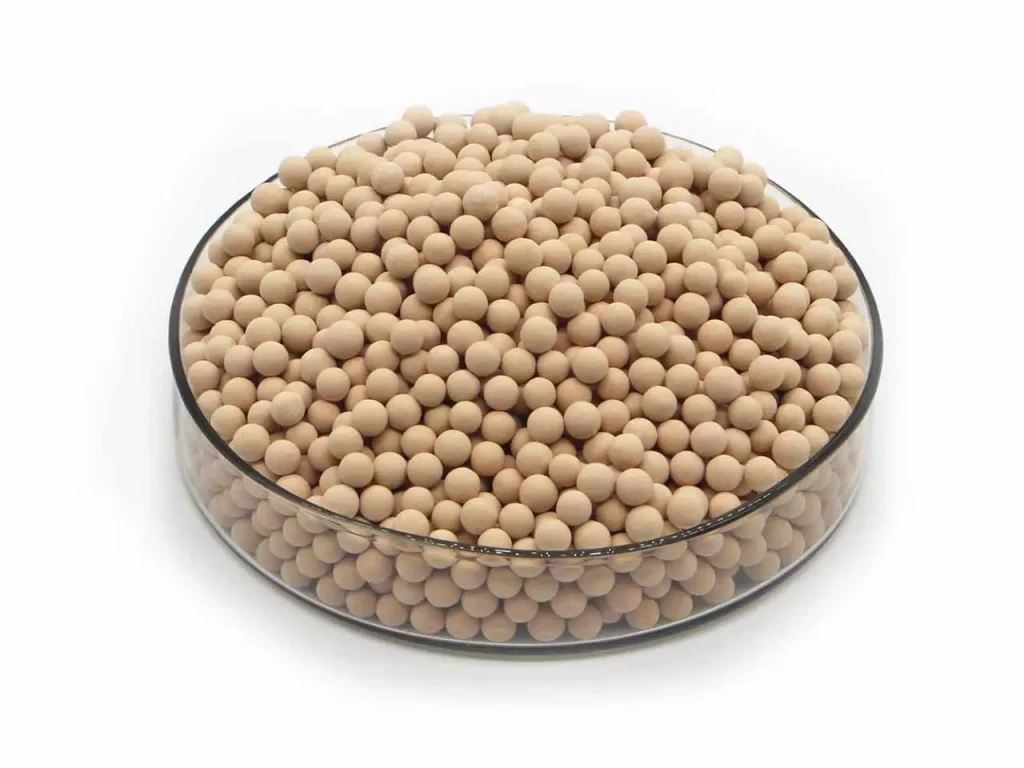
Traditional distillation and azeotropic distillation consume high energy and often fail to meet the requirements for deep dehydration. Molecular Sieve adsorption, with its high efficiency and ability to achieve deep water removal, has become the mainstream technology. Molecular sieve adsorbents are synthetic crystalline aluminosilicates with uniform micropores in the angstrom range, giving them exceptional selective adsorption capabilities. They are indispensable in the field of organic solvent dehydration.
Ⅱ. Adsorption Principle and Operation Process of Molecular Sieve for Solvent Dehydration
Adsorption Principle:
Molecular sieve dehydration is based on two synergistic effects: size sieving and polarity adsorption. The micropore size can be precisely controlled. Water molecules (kinetic diameter ~2.75 Å) are much smaller than most organic solvent molecules, so they can freely enter the pores and be firmly adsorbed, while larger solvent molecules are excluded. At the same time, water is highly polar, and molecular sieves have a strong affinity for it; most organic solvents (such as benzene, alkanes, etc.) are weakly polar or non-polar and are preferentially rejected in competitive adsorption. This enables highly selective deep dehydration.
Operation Process:
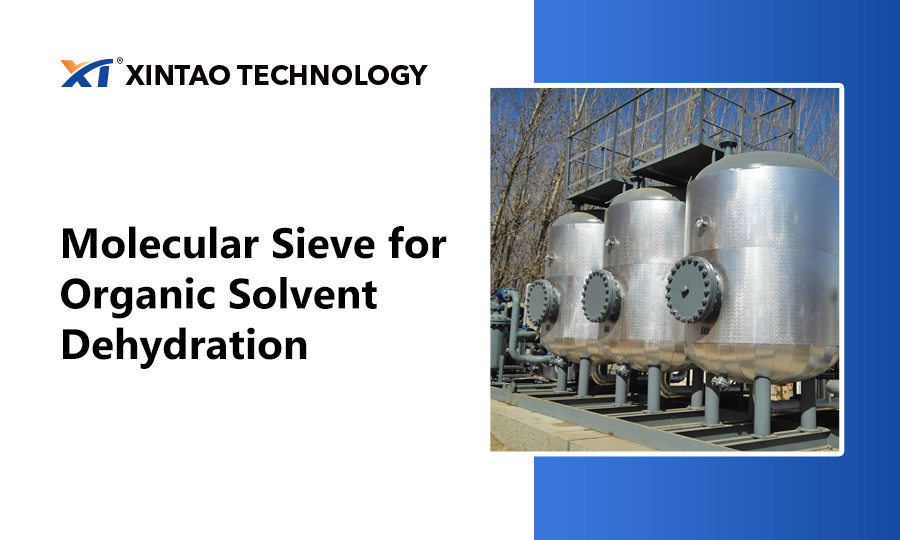
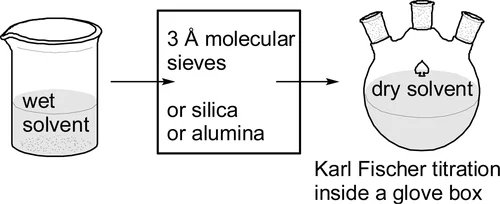
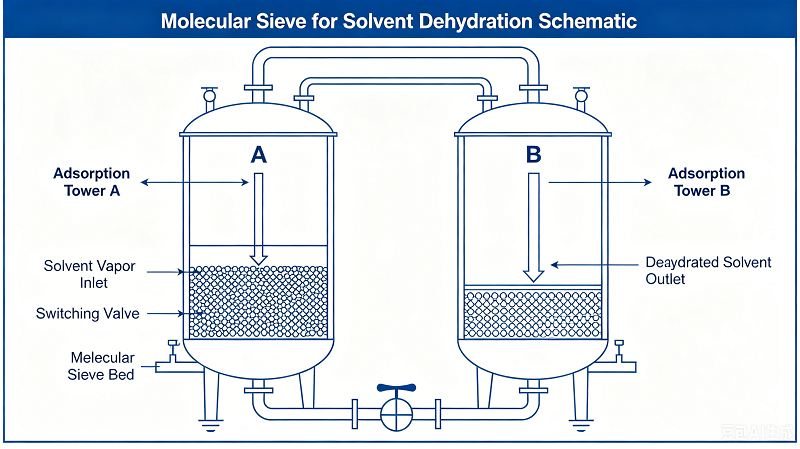
In a typical drying process, the solvent flows through an adsorption column packed with molecular sieve zeolite. Both water and solvent molecules may be adsorbed on the surface of the molecular sieve; however, the smaller water molecules enter and become trapped in the enormous internal surface area of the pores, thus being removed from the solvent. Therefore, using these desiccants, solvent dehydration can be achieved according to their adsorption efficiency and pore size characteristics. In most applications, the zeolite desiccant can be regenerated by heating to a specific temperature and reused.
Ⅲ. Selection of Molecular Sieve for Different Solvents
1. Selection of Molecular Sieves
Commonly used molecular sieve types include 3A, 4A, 5A, and 13X. Each type has different pore sizes and adsorption capacities. Correct selection is the key to efficient and economical dehydration.
Selection should consider the following factors:
- Size matching: The primary principle is to ensure that the pore size of the molecular sieve is smaller than the kinetic diameter of the solvent molecules to be dried, but larger than that of water. This allows water to enter and be adsorbed while the solvent molecules are excluded.
- Solvent polarity: Generally, polar solvents tend to use zeolite 3A molecular sieve or zeolite 4A molecular sieve; non-polar solvents can use 4A or 5Azeolite. However, thermal motion may allow slightly larger molecules (e.g., ethanol 4.4Å vs. 4A pore 4Å) to partially enter, so a smaller pore size is preferred when possible.
- Dehydration depth required: Different applications require different final water contents. Pharmaceutical-grade solvents typically require water levels in the single-digit ppm range; lithium-battery electrolytes require <20 ppm; general industrial solvents may only need to be reduced to a few hundred ppm. For extremely deep dehydration, 3A molecular sieves offer higher selectivity and can achieve outlet water content stably below 5 ppm.
2. The categories of organic solvents
New Energy / Lithium Battery Electrolyte and Additivese
- Main carbonate solventsfor lithium battery electrolytes: dimethyl carbonate (DMC), ethyl methyl carbonate (EMC), diethyl carbonate (DEC), ethylene carbonate (EC), propylene carbonate (PC). These commonly use 3A or 4A molecular sieves, with target water content typically <20 ppm, and for high-end applications <5 ppm.
- Functional additivessuch as vinylene carbonate (VC) and fluoroethylene carbonate (FEC), which are prone to hydrolysis or decomposition to produce HF, use 4A molecular sieve pellets to control water to the 20-ppm level.
- Lithium salt preparation solvents(e.g., for lithium hexafluorophosphate, LiPF₆) also use 3A or 4A to prevent decomposition upon contact with water.
Fluorochemicals / Electronic Cooling Fluids / Fire Extinguishing Agents
Perfluorohexanone (used as a fire extinguishing agent and cooling fluid), fluorinated cooling fluids (for immersion cooling in data centres), hexafluoroisopropanol, and hexafluoropropylene oxide – all these fluorinated materials require strict water control during synthesis or as final products. Because they have relatively large molecular sizes and are sensitive, zeolite 3A molecular sieve is recommended. It selectively adsorbs water without adsorbing the active components, thus avoiding side reactions. For fluorinated surfactants, selection depends on the specific solvent molecular size and should be determined case by case.
High-Purity Chemical Reagents / Specialty Solvents
- Alcohols (methanol, ethanol, anhydrous ethanol): 3A zeolite adsorbent for methanol ethanol drying is the preferred choice due to precise pore size matching.
- Nitriles(acetonitrile): Either zeolite 3A or 4A molecular sieves are suitable; static dehydration can reduce moisture levels to a few ppm.
- Ethers (tetrahydrofuran (THF), methyl tert-butyl ether (MTBE)): 3A zeolite is preferred for THF to prevent side reactions; 3A or 4A zeolites are generally suitable for MTBE.
- Ketones(acetone, methyl ethyl ketone): type 3A is recommended for superior selectivity.
- Esters (ethyl acetate, butyl acetate): Either 3A or 4A is suitable; the choice depends on specific operating conditions.
Ⅳ. Features of Xintao Molecular Sieve
Compared with traditional desiccants such as silica gel and activated alumina, and with conventional dehydration processes like distillation and azeotropic distillation, Xintao molecular sieves offer significant comprehensive advantages in organic solvent dehydration:
- Deep dehydration: Xintao molecular sieves can reduce water content to extremely low levels. For example, 3A molecular sieve adsorbent can achieve water content as low as5 ppm.
- High selectivity: Based on the molecular sieving effect, the sieves hardly adsorb solvent molecules, so solvent recovery is close to 100%, greatly reducing material loss.
- Good thermal and chemical stability: The zeolite structure remains stable at regeneration temperatures; it is insoluble in water and organic solvents and resistant to acids and alkalis.
- No chemical contamination: Dehydration is a physical adsorption process; no chemical impurities are introduced into the solvent, making it especially suitable for pharmaceutical and electronic-grade solvents.
- Reusable and regenerable: Xintao zeolite molecular sieves have high mechanical strength and abrasion resistance. They do not easily pulverise during gas flow impact or cyclic heating/cooling regeneration. Regeneration is usually done by heating at 250–350 °C with an inert gas purge.
| Molecular Sieve Type | Pore Size | Applicable Solvent Types | Typical Solvents |
3A | 0.3 nm | Polar small‑molecule solvents, unsaturated hydrocarbons, sensitive materials | Methanol, ethanol, isopropanol, acetone, butanone (MEK), acetonitrile, THF, ethyl acetate, butyl acetate, DMF, DMSO, perfluorohexanone, fluorinated cooling fluids, DMC, EMC, DEC, EC, PC, dichloromethane |
4A | 0.4 nm | Aromatics, halogenated hydrocarbons, carbonates, lithium‑battery additives | Toluene, xylene, chloroform, dichloromethane, diethyl ether, THF, DMF, DMC, EC, PC, VC, FEC, acetonitrile |
| 5A | 0.5 nm | Linear alkanes, cycloalkanes | n‑Hexane, cyclohexane, n‑butanol |
Ⅴ. Conclusion
Molecular sieves, as efficient, energy-saving, and environmentally friendly separation materials, are playing an increasingly important role in deep dehydration of organic solvents. With their precise pore size control, excellent selective adsorption, and outstanding regenerability, adsorbent 3A and 4A molecular sieves for solvent drying show unique value in different solvent systems.
Frequently Asked Questions
Q1: How long should the solvent be soaked with molecular sieve?
Usually 12–24 hours is recommended. For difficult-to-dry solvents, several days may be needed. Prolonged soaking is generally harmless.
Q2: Will the molecular sieve react with the solvent?
Pure molecular sieves are inert and generally do not react. However, caution is needed with solvents that are prone to condensation reactions, such as ketones, where molecular sieves may catalyse side reactions.
Q3: How do you dry lithium battery electrolyte solvents (e.g., carbonates)?
Typically, 3A or 4A molecular sieves (especially lithium-battery grade) are used to control water content below 20 ppm.
Q4: How is absolute ethanol prepared?
Industrially, 3A molecular sieve adsorption dehydration is widely used because its pore size effectively excludes ethanol molecules.
Q5: Why choose Xintao molecular sieve?
Xintao is a molecular sieve manufacturer with over 20 years of experience, offering high-quality, high-performance products with excellent adsorption capacity and efficiency. We also provide free samples for customers to test, allowing you to see the performance of Xintao molecular sieve adsorbent pellets firsthand.
Contact Us
Company Name: Jiangxi Xintao Technology Co., Ltd.
Email: export@xt988.com
Whatsapp: 13576431259
Address: Xintao Technology Industrial Park, New Third Board Industrial Park, Pingxiang City, Jiangxi Province