Table of Contents
ToggleOxygen Molecular Sieve:Replacement Cycles and Assessment
The replacement cycle for oxygen molecular sieves is a critical indicator for ensuring both the oxygen production performance and operational safety of the equipment. This replacement frequency is not a fixed value; rather, it requires a comprehensive assessment based on various factors, including the specific type of molecular sieve, operating conditions, and maintenance standards. Establishing a rational replacement cycle and employing scientific assessment methods can effectively prevent issues—such as diminished oxygen purity or equipment failure—caused by delayed replacement, while also avoiding the waste of resources resulting from premature replacement.
Key Influencing Factors of Oxygen Molecular Sieves Replacement Cycles
The primary factors determining the lifespan of oxygen generation molecular sieves are contamination and operational intensity, rather than mere cumulative operating time. Foremost among these factors is the quality of the feed gas (air). If the air pretreatment system is inadequate—allowing impurities such as moisture, oil residue, or dust to enter the adsorption towers—the pores within the molecular sieves may become clogged. Consequently, the replacement cycle could be shortened from the standard 5–8 years to just 3–4 years. Secondly, the intensity of usage and specific operating conditions also dictate the replacement cycle.
For household oxygen concentrators, continuous operation for 8–10 hours daily will shorten the replacement cycle by 20%–30% compared to intermittent use (2–3 hours daily). For industrial oxygen generators operating continuously for 24 hours, the replacement frequency is typically 1.5 to 2 times higher than that of equipment operating intermittently. Furthermore, operating pressure and temperature also influence the replacement cycle; excessively high regeneration temperatures (e.g., exceeding 400°C) can cause the crystalline structure to collapse, resulting in irreversible thermal damage. Operation within standard pressure ranges (e.g., 0.5–0.8 MPa) ensures the greatest stability, whereas excessive pressure fluctuations can accelerate wear and tear.
Replacement Patterns Across Different Scenarios
The replacement cycles for molecular sieves in household versus industrial oxygen generators differ significantly due to their distinct application environments.
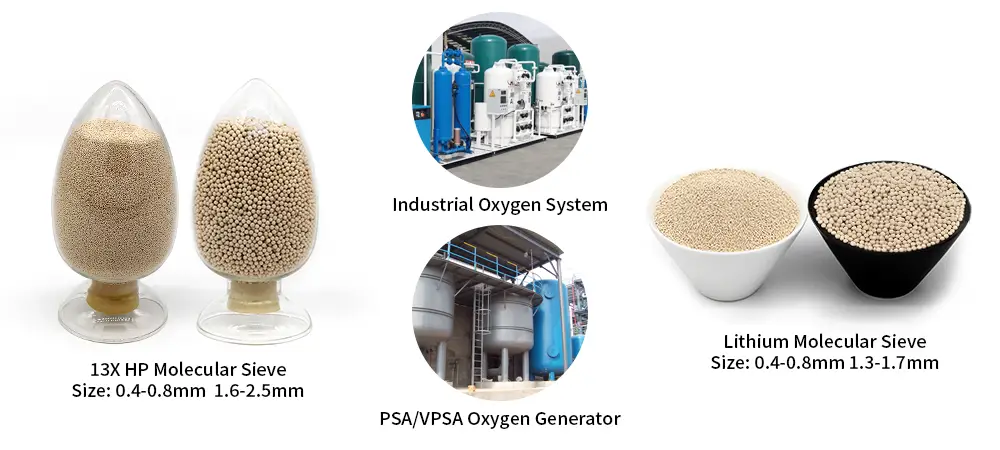
Household oxygen concentrators typically utilize 13X HP molecular sieves. In a standard home environment (characterized by good ventilation and moderate humidity), the replacement cycle is generally 5–7 years. However, if the operating environment is humid or the air quality is poor, the replacement cycle must be shortened to 4–5 years; for units used for more than 8 hours daily, the replacement cycle is reduced to 2–3 years.
Industrial oxygen generators exhibit significant variations depending on specific operating conditions. Systems utilizing medium-to-high-pressure 5A molecular sieves (1.0–2.0 MPa) typically have a replacement cycle of 8 to 10 years. Low-pressure systems employing 13X molecular sieves (0.5–0.8 MPa) have a replacement cycle of 6 to 8 years. Oxygen generation systems utilizing lithium molecular sieves via the VPSA process can achieve a replacement cycle of up to 8 years. However, for oxygen generators deployed in industrial environments characterized by high dust levels or high humidity, the replacement cycle must be shortened to 3 to 5 years, and the frequency of intermediate inspections must be increased.
Scientific Methods for Assessing Oxygen Molecular Sieves
In addition to referencing standard replacement cycles, it is essential to utilize both performance monitoring and physical inspections to determine whether replacement is necessary. Regarding performance monitoring, the oxygen generator’s built-in purity analyzer should be consulted. If the oxygen purity falls below established standards (≥93% for medical grade; ≥88% for industrial grade) or if the oxygen output volume has declined by more than 20% compared to a new unit, it indicates that the molecular sieves’ adsorption capacity has severely deteriorated.
Simultaneously, one should observe pressure fluctuations within the adsorption towers; if a significant amount of white powder is observed at the nitrogen exhaust port, or if pressure fluctuations exceed ±0.1 MPa, it may indicate abnormal airflow resistance caused by the pulverization of the molecular sieves.
Physical inspection serves as the most intuitive assessment method; it requires shutting down the equipment and opening the adsorption tower. If the molecular sieve desiccant granules appear dark brown, show signs of oil contamination or clumping, or crumble easily into powder when rubbed by hand, it signifies that the molecular sieves have failed and must be replaced immediately—reliance solely on accumulated operating time is insufficient for making this determination.
Replacement Procedures and Important Considerations
Replacing oxygen generation molecular sieves requires strict adherence to standardized procedures to ensure optimal equipment performance.
Prior to replacement, the equipment’s power supply must be disconnected. After depressurizing the system, the end cap of the adsorption tower should be removed to clear out the failed molecular sieve material; the interior of the tower must then be purged with dry nitrogen to prevent impurities from contaminating the new molecular sieve adsorbents.
During replacement, zeolite molecular sieves specifically matched to the equipment model must be selected and packed into the tower evenly and densely to prevent the formation of voids that could lead to airflow “short-circuiting.”
Following replacement, the adsorption tower must undergo a leak-tightness test. Subsequently, dry air should be introduced to activate the new sieves for 4 to 6 hours; the equipment may be returned to active service only after the oxygen purity has stabilized and meets the required standards. Furthermore, spent molecular sieves are classified as general industrial waste; they must be disposed of properly in accordance with environmental regulations and must not be discarded indiscriminately.
Contact Xintao
If you have any question, please contact us!