Table of Contents
ToggleMolecular Sieve for Drying in the Plastics Industry
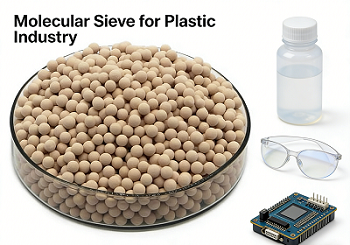
In the plastics industry, molecular sieve is primarily used for deep dehumidification and drying of hygroscopic engineering plastics (such as PET, PA, PC, and ABS), a crucial pretreatment process to ensure the quality of the final product.
The core principle is to utilize the micropores of the molecular sieve adsorbent to preferentially adsorb moisture from the surface of plastic particles under heating conditions, reducing the plastic’s moisture content to extremely low levels. This prevents defects such as hydrolytic degradation, silver streaks, and bubbles from occurring during subsequent high-temperature processing.
Molecular Sieve Working Principle
Hot, humid process air (exhausted from the top of the drying hopper) flows through the molecular sieve adsorption bed, where moisture is captured and the air is deeply dried. The saturated molecular sieve bed is then switched to regeneration mode, where high-temperature air at 200-350°C is introduced to desorb and remove the moisture. The regenerated high-temperature molecular sieve needs to be cooled to its operating temperature to restore optimal adsorption capacity. Subsequently, a dual-tower or multi-tower system alternates between adsorption and regeneration to achieve continuous and stable deep dehumidification.
Molecular Sieve Desiccant Selection
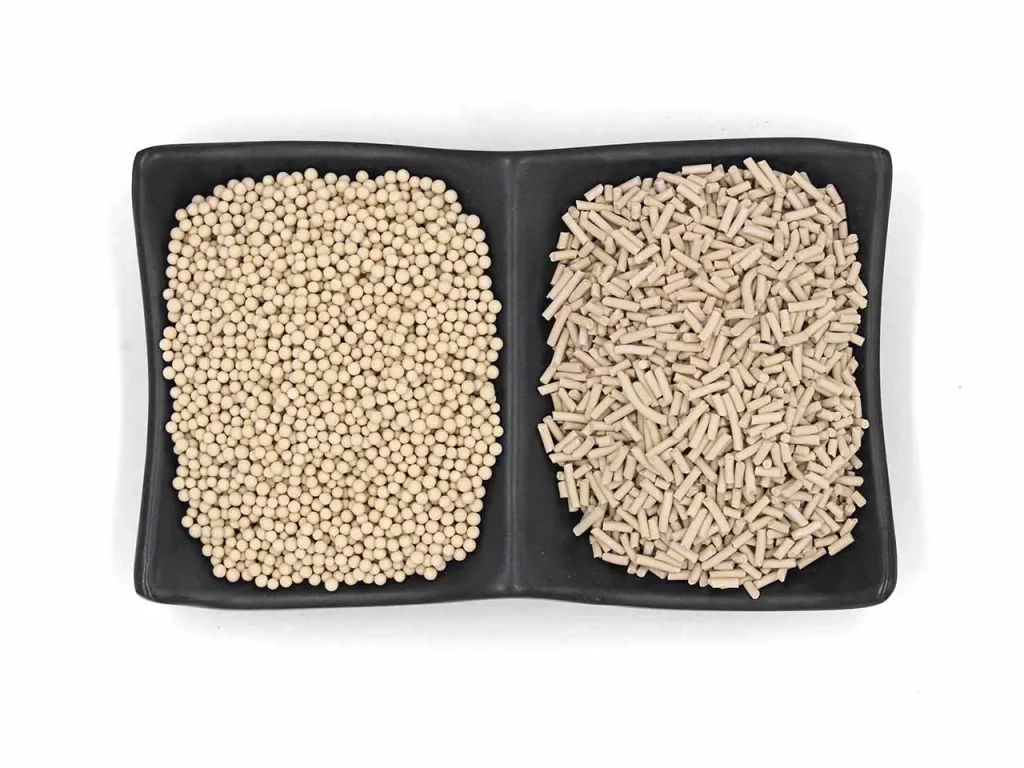
3A molecular sieves are the preferred choice. With a pore size of only 3 angstroms, they can effectively remove moisture and almost never adsorb larger organic molecules such as monomers and plasticizers that may volatile in plastics, ensuring a long service life. In addition to static water adsorption capacity, crush resistance and abrasion rate are crucial, as they directly determine whether the molecular sieve is easily pulverized under continuous airflow, thus affecting system life and plastic cleanliness.
Application Scenarios
- Polyethylene terephthalate (PET) industry: Bottle flake recycling and granulation, and fiber production are the largest application areas. Deep drying is the lifeline for preventing hydrolytic degradation and ensuring product viscosity and strength.
- Polyamide (Nylon, PA) processing: Whether for automotive parts or electronic components, thorough drying is fundamental to achieving the desired high strength and toughness.
- Optical grade and specialty plastics: When polycarbonate (PC) and acrylic (PMMA) are used in lenses and light guides, even trace amounts of moisture can cause optical distortion and appearance defects.
- High-temperature engineering plastics, such as PEEK and PEI, require even higher processing temperatures and have more stringent requirements regarding moisture content.
In conclusion, the application of zeolite molecular sieves in dehumidification and drying within the plastics industry is far from a simple auxiliary step; rather, it is a core process that directly impacts the upper limits of material properties and product yield. It represents a technological leap from simply “being able to process” to “being able to consistently process high-quality products.”
Contact Xintao
If you have any question, please contact us!