Table of Contents
ToggleApplication Of Xintao Molecular Sieve 3A Zeolite
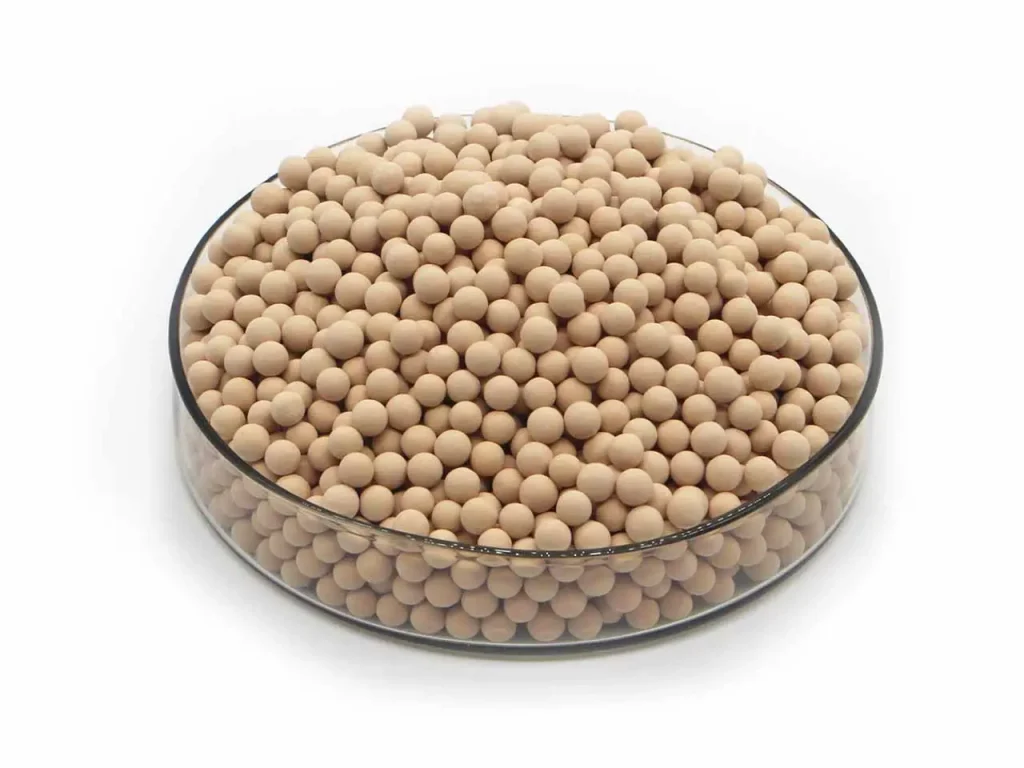
Xintao molecular sieve 3A, a type of zeolite-based adsorbent, plays a critical role in industrial drying and dehydration processes. It is widely applied in ethylene plants, pyrolysis gas dryers, air separation plants, and more, with core uses focused on removing moisture from petroleum-related gases, olefins, and solvents. This article will detail its raw material and manufacturing process, classification context among molecular sieves, main application scenarios, and specific industrial cases to showcase its practical value.
Basic Information of Xintao Molecular Sieve 3A
Xintao zeolite 3A molecular sieve works in ethylene plants, pyrolysis gas dryers, and air separation plants. Manufacturers use zeolite powder as its raw material, and during processing, they need to conduct Na ion exchange treatment on the powder. After roasting the treated powder at high temperatures to remove water, the molecular sieve zeolite gains the ability to absorb water and can also adsorb other molecules.
- Type A is further divided into 3A, 4A, and 5A.
- Type X includes 10X and 13X.
- Type Y is often used as an additive for high-efficiency catalysts, mainly in petroleum cracking.
Main Application Scenarios of Xintao Molecular Sieve 3A
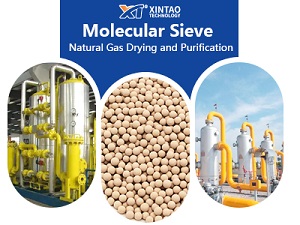
Xintao molecular sieve 3A is mainly used to dry petroleum cracking gas, refinery gas, oilfield gas, and olefins. For example, it dries ethylene, acetylene, propylene, and butadiene, and also dehydrates alcohols and various solvents.
Additionally, to prevent the adsorption of hydrocarbons above ethane, it is also applied in the dehydration of rich natural gas. The following are its specific application examples:
Application Example 1: Dehydration of Isopropanol
Isopropanol is an important chemical raw material and organic solvent, widely used in the chemical and pharmaceutical industries. In its industrial production process, a large amount of isopropanol-water mixed waste liquid is generated, so achieving complete separation of isopropanol and water is of great significance.
Here, 3A molecular sieve adsorbent shows obvious advantages: it has a strong adsorption effect on moisture in isopropanol, has a good regeneration effect, and can directly produce high-concentration isopropanol. Specifically, this application has the following characteristics:
- The water absorption of molecular sieve 3A has little correlation with the state of isopropanol (gaseous or liquid).
- The adsorption capacity of 3A molecular sieve desiccant for pure isopropanol is closely related to the adsorption state, with the lowest capacity in the gaseous state.
- Nearly a hundred experiments have confirmed that the molecular sieve has a good regeneration effect, a long service life (can be used continuously for more than two years according to the manufacturer), and is easy to operate.
- Since zeolite 3A molecular sieve can dehydrate isopropanol vapor, it can be combined with ordinary distillation towers to achieve energy conservation and consumption reduction.
Application Example 2: Adsorption of Trace Water in Ethyl Acetate Solution
Ethyl acetate usually contains a certain amount of water, forming an azeotrope with it. Under normal pressure, the mass fraction of water in the azeotrope is 8.5%. To obtain high-purity ethyl acetate, refining treatment is necessary.
Common refining methods include: adding an accelerator for extraction refining, adding an azeotroping agent for azeotropic distillation, and acetic acid extraction reaction rectification. These methods consume large amounts of energy.
Molecular sieve 3A beads has strong water adsorption capacity, simple operation, and easy regeneration. Using it to absorb water in ethyl acetate solution can directly produce high-purity ethyl acetate, with a simple production process and low energy consumption.
However, further research is needed on: the regeneration conditions during the cyclic adsorption process of 3A molecular sieves, the adsorption effect after regeneration, the internal structural changes of the molecular sieve after cyclic adsorption and their causes, as well as how to reduce the deactivation rate, prolong the service life of the molecular sieve, and improve the efficiency of the overall process.
Contact Xintao
If you have any question, please contact us!